
Smith Family Farm Atlanta: Read the Gardens as History |
Visit Smith Family Farm Atlanta with time for the gardens, the history of enslavement and a carefully paced Atlanta History Center outing. |
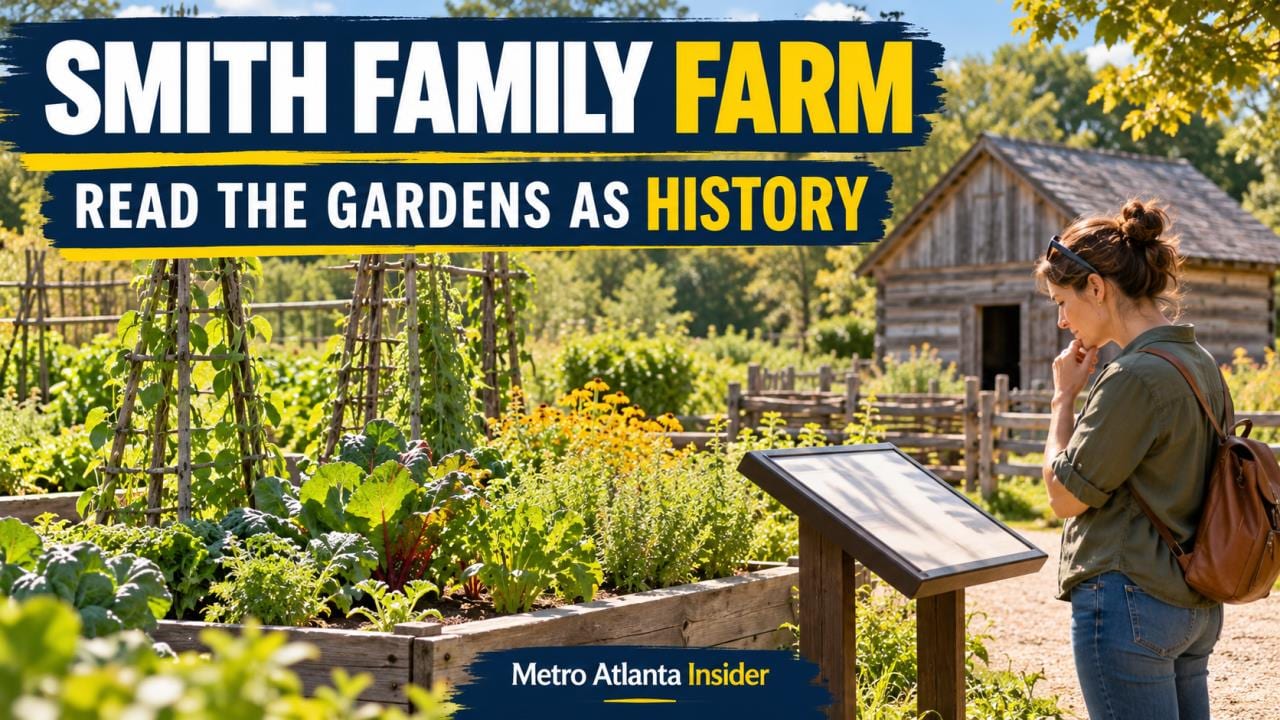
Smith Family Farm in Atlanta rewards a slower visit than a quick photograph of an old farmhouse. At Atlanta History Center, the buildings, garden spaces and livestock help interpret agricultural life alongside the history of enslavement. Plan enough time to understand whose work sustained that landscape.
The center's Smith Farm overview describes a representation of an Atlanta-area slaveholding farm of the 1860s, with historic buildings relocated for preservation. That distinction matters: this is an interpreted historic landscape, and visitors should read labels rather than assume every structure stands on its original site.
Begin with the Buckhead campus visitor information. Atlanta History Center lists its main address as 130 West Paces Ferry Road NW, with free on-site parking. The campus opens Tuesday–Sunday, 9 a.m.–4 p.m., while historic houses open at 11 a.m. An early campus arrival therefore does not mean every interior is available immediately.
Check current admission and any date-specific arrangements before buying tickets. Decide whether Smith Farm is the main purpose or one part of a larger campus visit. A clear priority keeps a household from spending its attention on logistics before reaching the places it came to see. |
 Photo by Jordan Coleman on Pexels — Illustrative sheep photograph; not Smith Farm or its livestock. |
Look beyond the farmhouseThe center's Enslaved People's Cabin and Garden interpretation explains that the original enslaved people's cabins did not survive. A comparable historic cabin was relocated to the campus in 1973. Its interpretation addresses daily life, community, mistreatment and resistance rather than presenting the building as a picturesque backdrop.
Let that context guide the conversation with children. Ask who owned the farm, who was forced to work there and how a garden could serve a household under oppression. Keep answers connected to the institution's interpretation, and acknowledge questions that need more reading instead of inventing a reassuring story.
The Smith Farm Gardens description identifies historic crop varieties, a kitchen garden, an enslaved people's garden and heirloom flowers. These spaces can help visitors consider food, labor and knowledge together. Seasonal growth varies; a plant named online is not guaranteed to be visible on the day you arrive.
Heritage-breed livestock also form part of the interpretation. Observe animals according to staff directions and posted boundaries. Do not assume a farm visit includes feeding, petting or a scheduled demonstration. If one activity is essential to the outing, verify its current availability before promising it to a child. |
 Photo by LUIS GALLARDO on Pexels — Illustrative vegetable-garden photograph; not Smith Farm or its historic gardens. |
Leave time to connect the storiesFor a focused visit, choose one garden or building to examine closely, then compare what the labels reveal about different people's lives. Short pauses for questions can be more useful than covering every stop quickly. Bring footwear appropriate to an outdoor portion of a museum visit and dress for the forecast.
If adding the Cyclorama, use our hourly-presentation planning guide to arrange that separate part of the day. If the visit raises a family or local-history question, our Kenan Research Center appointment guide explains how to prepare a later research visit. Neither should crowd out time to understand the farm itself.
Before leaving, ask each companion to name one piece of evidence that changed their understanding. Keep the distinction between preserved buildings, reconstructed settings and documented experiences clear. Smith Farm is most useful when its gardens and structures become starting points for thoughtful history, rather than simply the next attractive stop on campus. |
0 Comments
Join the conversation
Be the first to comment
Share your thoughts above.